By Alex Ridgeway
I was particularly interested to read Gavin Moody and colleagues’ recent study examining changes in hoof morphology in Thoroughbred racehorses during a 90-day period without shoes. Gavin deserves congratulations for contributing further objective research to an area of Thoroughbred hoof management that warrants considerably more attention.
What caught my interest was how closely some findings reflected research I carried out in 2021. Although the studies differ in methodology and the horses involved, both demonstrate that the Thoroughbred foot can undergo measurable morphological changes over a relatively short period without shoes, particularly within the heel region. The more interesting question is what those findings might teach us about horses that need to remain shod.
Looking back at my 2021 research
My dissertation followed 14 Thoroughbred racehorses over approximately 90 days, comparing nine horses managed barefoot with five that remained shod. The objective was to examine changes in hoof morphology, with particular attention to the relationship between the dorsal hoof wall and heels.
In the barefoot group, mean heel angle increased from 34.08° to 42.01°, while mean heel height increased from 2.13 cm to 2.66 cm. The difference between dorsal hoof wall and heel angles reduced from 16.11° to 10.64°. The shod group showed little change in mean heel angle, remaining close to 34° over the study.
These observations suggest that changes were occurring within the heel region itself, rather than simply through shortening the toe. However, the study was relatively small and its groups were not directly equivalent to those in the later research.
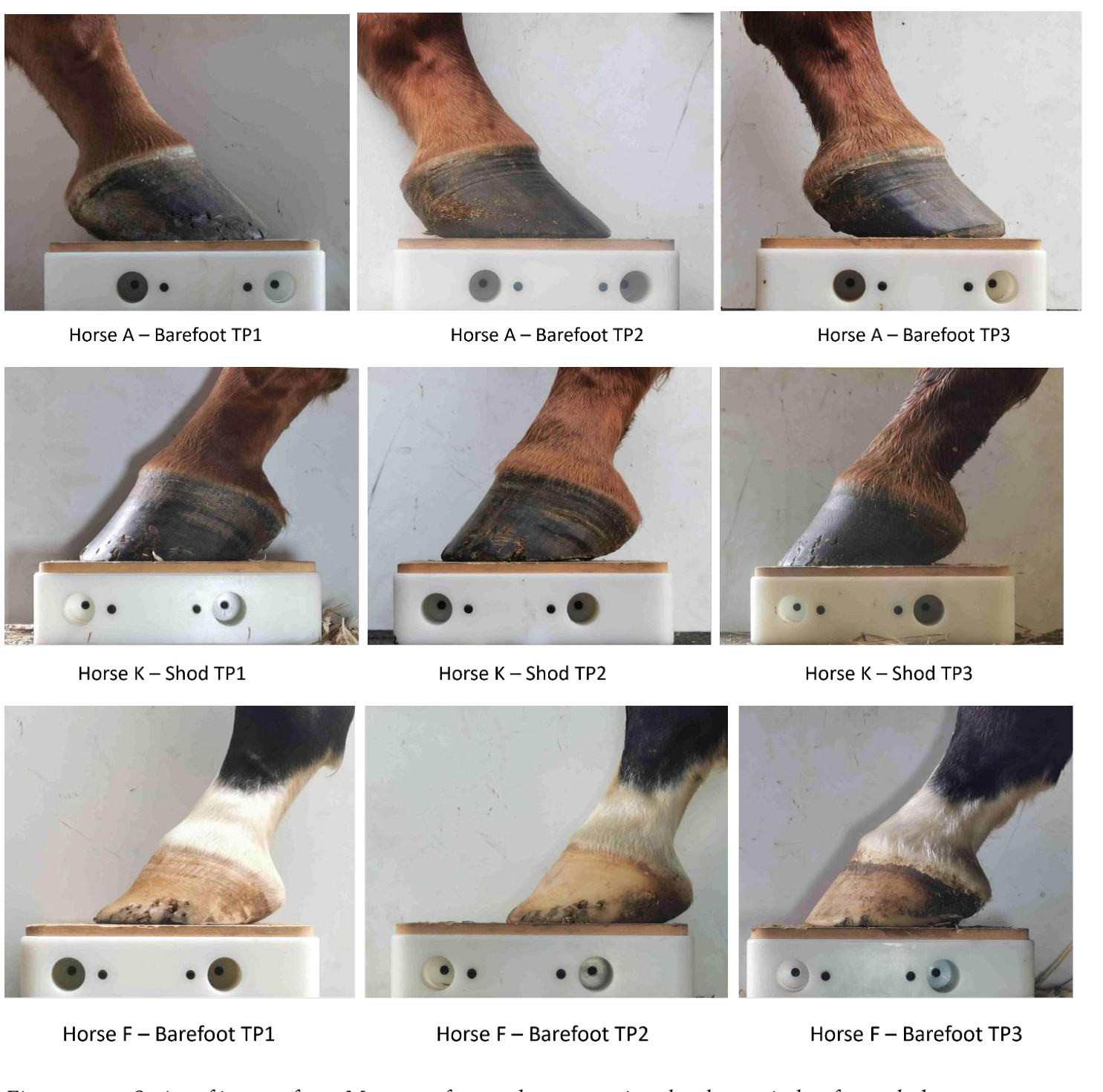
Figure 1. Serial lateral photographs of three Thoroughbreds across TP1, TP2 and TP3: Horse A (barefoot), Horse K (shod) and Horse F (barefoot). The photographs illustrate individual changes in hoof capsule profile over the study period. Source: Ridgeway (2021).
What Moody and colleagues add
Moody and colleagues investigated 36 Thoroughbred racehorses, including 23 managed unshod and 13 shod controls, over 90 days. An important difference is that these horses remained in active training, whereas my 2021 cohort was managed under reduced or lighter workloads.
In the unshod group, mean heel angle increased from 29.97° to 34.62°, while the dorsal wall–heel angle difference reduced from 21.25° to 16.69°. The dorsal wall angle remained comparatively stable. The between-group change in heel angle was statistically significant; the corresponding between-group comparison for the dorsal wall–heel angle difference was not. That distinction matters when interpreting the strength of the evidence.
The results side by side
Comparison of the two studies:
· Total horses: Ridgeway (2021): 14; Moody et al. (2026): 36.
· Unshod / shod: Ridgeway (2021): 9 / 5; Moody et al. (2026): 23 / 13.
· Study period: Ridgeway (2021): Approximately 90 days; Moody et al. (2026): 90 days.
· Initial mean heel angle (unshod): Ridgeway (2021): 34.08°; Moody et al. (2026): 29.97°.
· Final mean heel angle (unshod): Ridgeway (2021): 42.01°; Moody et al. (2026): 34.62°.
· Change in mean heel angle: Ridgeway (2021): +7.93°; Moody et al. (2026): +4.65°.
· Initial dorsal wall–heel angle difference: Ridgeway (2021): 16.11°; Moody et al. (2026): 21.25°.
· Final dorsal wall–heel angle difference: Ridgeway (2021): 10.64°; Moody et al. (2026): 16.69°.
Both studies recorded an increase in heel angle in their unshod cohorts, although the horses began with different measurements and management histories. We cannot infer that one population had been managed better or worse, nor attribute differences in response to a single factor.
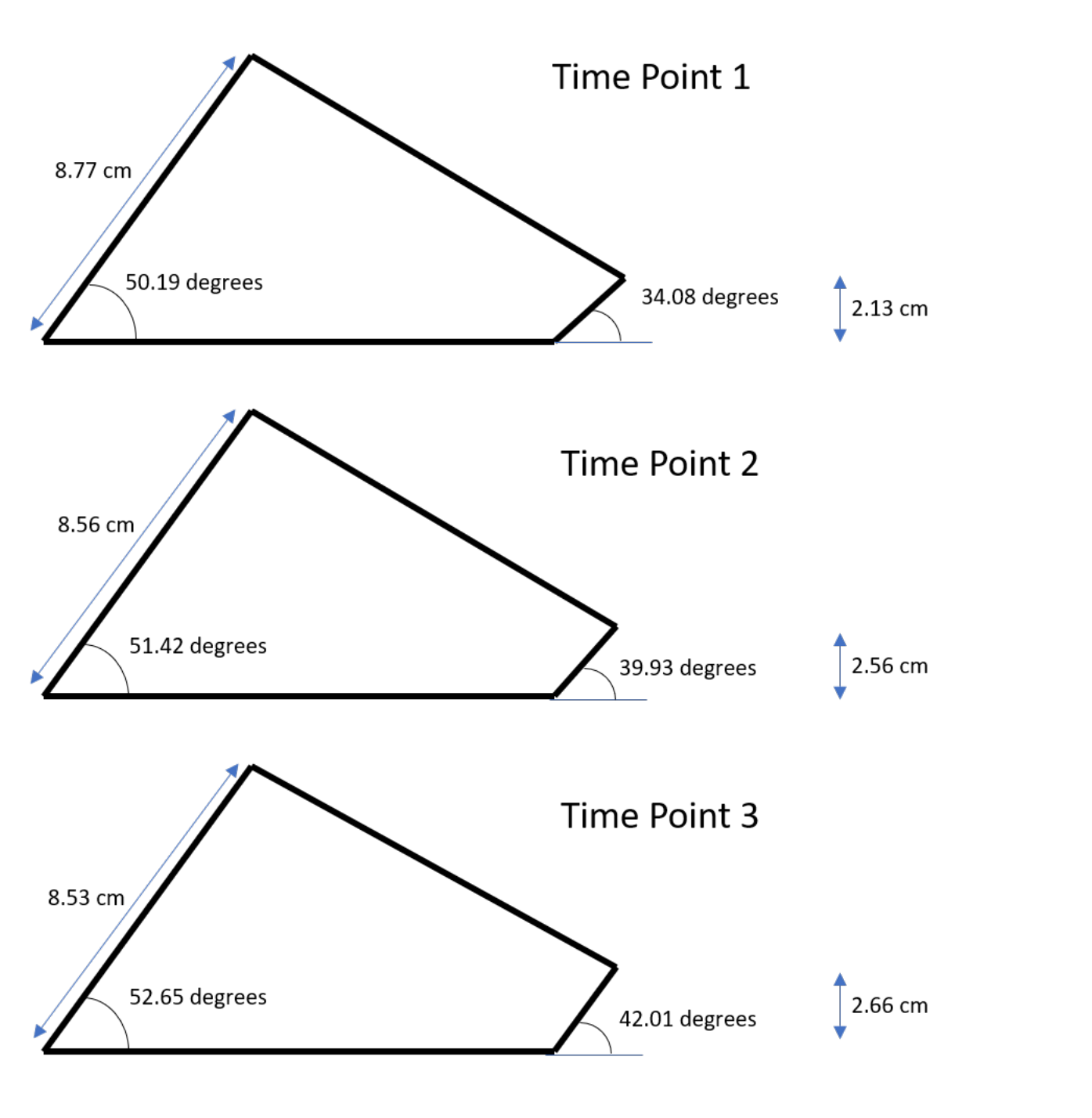
Figure 2. Mean lateral hoof dimensions at TP1, TP2 and TP3 in Ridgeway (2021). Heel angle increased from 34.08° to 42.01°, and heel height from 2.13 cm to 2.66 cm; the figure also records dorsal wall angle and length. Original measured diagram, reproduced from the dissertation.
Does the farriery interval matter?
My 2021 research followed a standard 21-day shoeing protocol, with measurements generally collected at approximately 18–21-day intervals. Moody and colleagues aimed to maintain an interval close to 30 days. This difference raises an interesting question: could a shorter interval help limit the development of hoof capsule distortion between appointments?
As a hoof grows, its proportions and loading characteristics may change, so the balance achieved immediately after shoeing is not necessarily maintained throughout the cycle. Neither study directly compared 21-day and 30-day shoeing intervals; consequently, the observed differences cannot be attributed to interval length alone. It remains a useful question for controlled investigation.
Age, training and hoof growth
Moody and colleagues reported a negative correlation between age and dorsal hoof wall angle. But is this an effect of biological ageing, or could it partly reflect cumulative training exposure? Peel, Peel and Davies (2006) reported reductions in hoof angle during periods of gallop training, with increases during rest. Age, workload and shoeing history are difficult to separate without specifically measuring their independent effects.
In my own practice, I often observe that two-year-old Thoroughbreds appear to produce more hoof growth than older horses. This remains a clinical observation, not a finding established by these studies. We should also distinguish the rate of horn production from the amount of hoof wall available to remove at trimming.
If less material is available for correction as a horse matures, preserving a functional hoof capsule between shoeing appointments becomes even more important. That is a hypothesis worth testing, rather than a conclusion we can yet claim.
What might be happening mechanically?
Removing shoes changes the interface between hoof and ground, potentially affecting contact through the frog, sole and heel region. Moody and colleagues discuss altered palmar contact and loading as possible contributors to the observed improvements. Neither study directly establishes the precise mechanism.
The practical question is whether we can better preserve healthy heel morphology in shod horses through careful interval management, appropriate shoe design, material selection or changes to the way the palmar hoof engages with the ground. Newer compliant materials including frog support systems and hoof packing are interesting possibilities, but require objective testing before efficacy can be claimed.
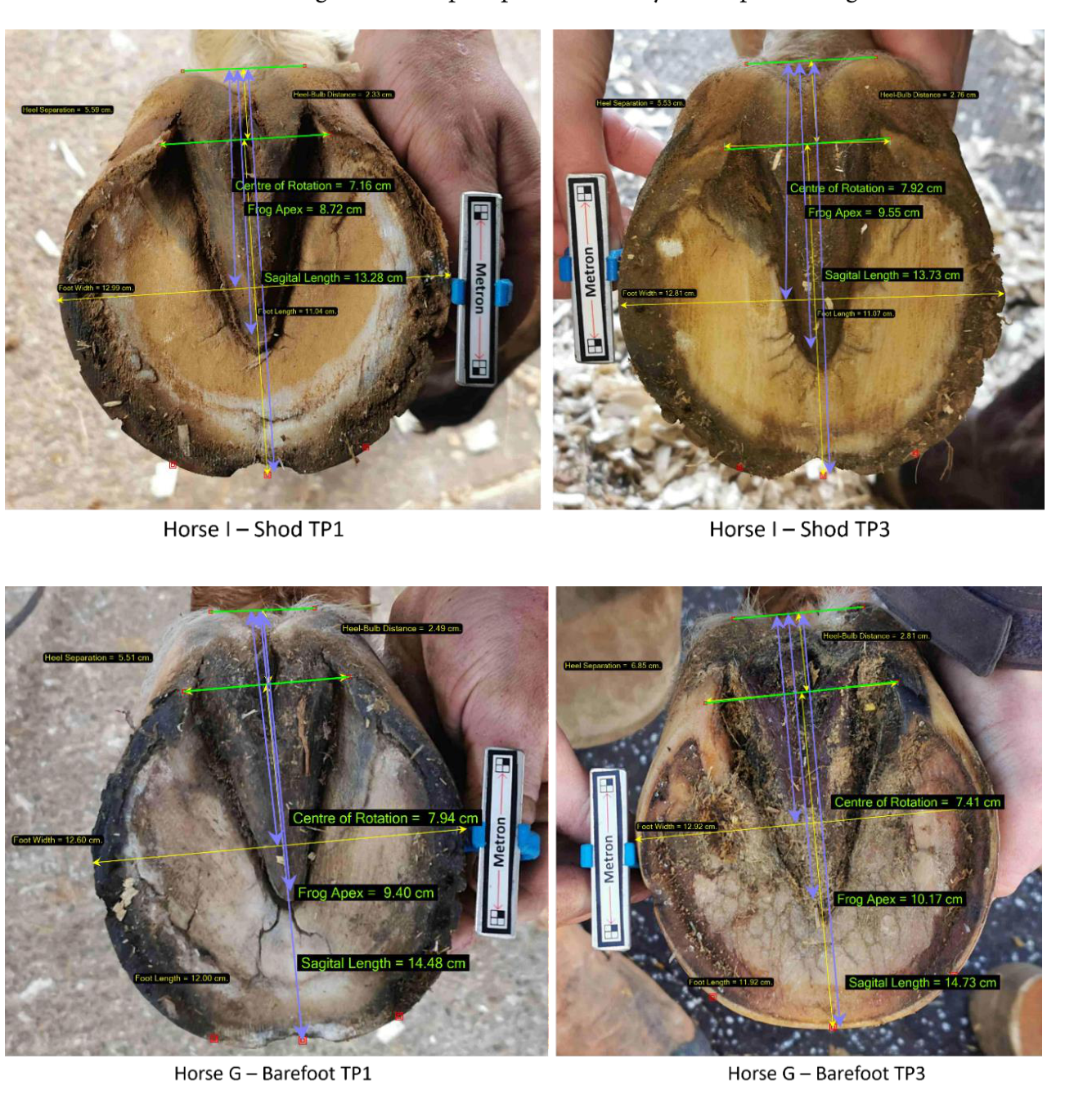
Figure 3. Solar photographs comparing Horse I (shod; TP1 and TP3, upper row) with Horse G (barefoot; TP1 and TP3, lower row). Original measurement annotations show the recorded dimensions, including heel separation, heel-bulb distance and sagittal length. These are examples from individual horses, not a population-wide effect. Source: Ridgeway (2021).
What this means for the shod Thoroughbred
The discussion should not become a simplistic argument for barefoot management. Horseshoes remain essential for many horses in professional racing yards, where workload, surfaces, individual hoof characteristics and racing requirements vary. The more useful questions are whether we assess hoof balance frequently enough, whether our intervals match the rate at which each foot changes, and whether shoeing management can better preserve heel function and hoof capsule integrity.
Good farriery is not simply correcting the foot at each appointment. It is the ongoing management of hoof geometry, loading and structural strength across the training cycle. The objective should be to minimise distortion rather than repeatedly respond to it once established.
Where do we go from here?
Five years after my own research, it is encouraging to see further work demonstrating the capacity for measurable changes in Thoroughbred hoof morphology during periods without shoes. We still need better evidence about the mechanical causes, how they vary with training and age, and which approaches can transfer those benefits to horses remaining shod.
Barefoot rehabilitation demonstrates what the hoof is capable of. Good farriery should investigate how much of that healthy morphology we can preserve while the horse remains shod.
These are questions I intend to explore further in my forthcoming book, How to Manage the Thoroughbred Racehorse, with a particular focus on hoof development, balance and the demands of training and racing.
Research references
Ridgeway, A. (2021). The morphological changes in Thoroughbred racehorse feet following a period of barefoot rehabilitation. BSc (Hons) Farriery Science dissertation, University of Central Lancashire / Myerscough College. Unpublished.
Moody, G. R., Curtis, S. J., Northrop, A. J. & Martin, J. H. (2026). Changes in hoof morphology in racing Thoroughbreds during a period of ninety days unshod. Frontiers in Veterinary Science, 13, 1863433. https://doi.org/10.3389/fvets.2026.1863433
Peel, J. A., Peel, M. B. & Davies, H. M. S. (2006). The effect of gallop training on hoof angle in Thoroughbred racehorses. Equine Veterinary Journal, 38(S36), 431–434. https://doi.org/10.1111/j.2042-3306.2006.tb05582.x